Ciabatta vs Focaccia
The difference in hydration, crumb and flavour between Ciabatta and Focaccia at Pan Pan.
Standing in front of the bread shelf at Pan Pan, it is easy to hesitate between Ciabatta and Focaccia. Both breads start from a similarly wet dough, but the path to the finished loaf — and the result on your table — differs quite a bit.
Ciabatta is made with a high-hydration dough, meaning a lot of water relative to flour. That is exactly what gives the crumb its characteristic irregular structure, with larger and smaller holes scattered throughout the loaf. The crust is thin and crackly, and the loaf itself is long, dusted with flour on top. It is sliced into pieces and makes an excellent choice for a sandwich — sturdy enough to hold its shape, while the crumb soaks up olive oil or sauce nicely without falling apart.
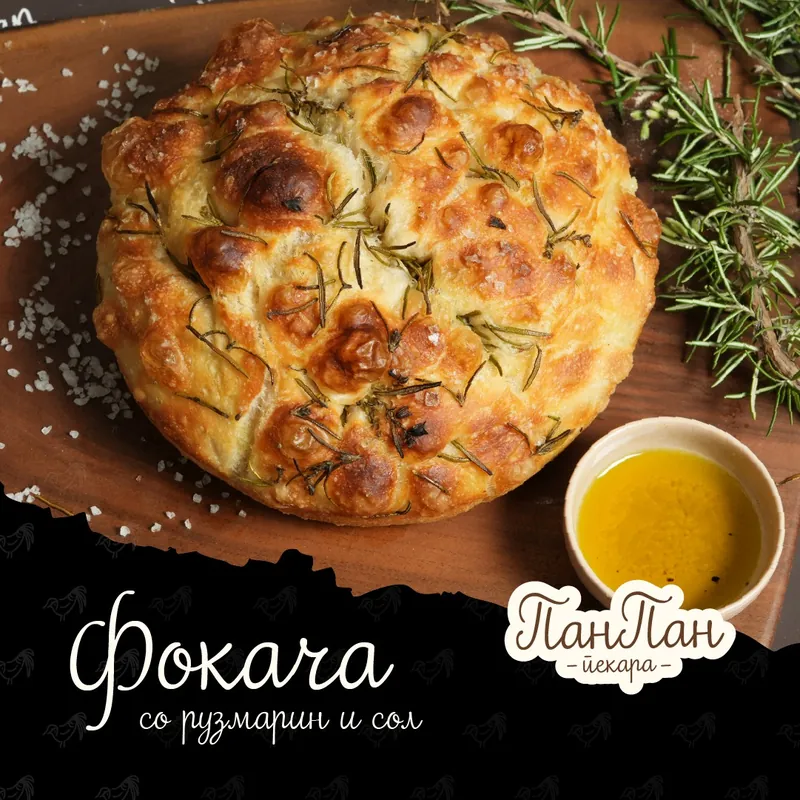
Focaccia, on the other hand, is flatter and richer, with olive oil not just as an addition but as part of the dough itself and of the surface. Before baking, the top is dimpled with fingertips and drizzled with oil, often finished with sea salt, rosemary or olives on top. The crumb is denser and moister compared to Ciabatta, and the taste of olive oil comes through in every bite. Focaccia is eaten on its own, as a snack in itself, but also works as a base for bruschetta or alongside a warm soup.
The difference in how much oil is used is one of the key distinguishing points. With Ciabatta, oil is mainly worked into the dough or served alongside for dipping, while with Focaccia the oil is literally painted onto the surface and folded into the dough before baking, giving a richer, more aromatic result.
If crisp crust and a light, airy crumb for a sandwich matter to you, Ciabatta from Pan Pan is a safe choice. If you are after a bread with a pronounced olive oil flavour, a denser texture and the smell of herbs, then Focaccia is the piece you will reach for while it is still warm.
Both breads are part of our everyday offering at Pan Pan, baked according to the same craft principles we apply to every other loaf — patience with fermentation and attention at every step. The difference is not in quality, but in character: Ciabatta is the light, crisp companion to a sandwich, while Focaccia is the denser, richer piece that is satisfying enough on its own.
Next time you stand in front of the counter, try both — the difference in crumb and olive oil flavour will be obvious right away.