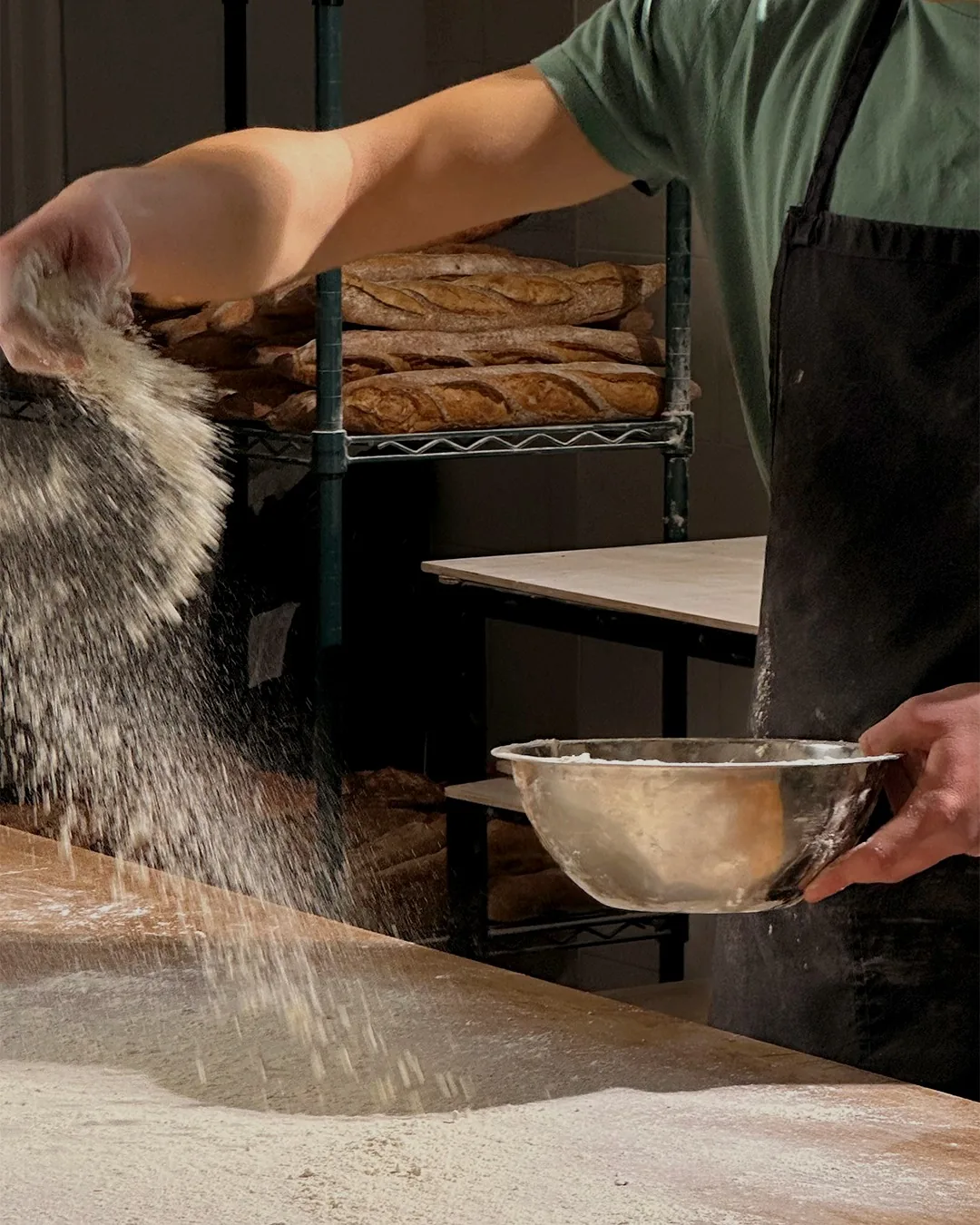
What happens in the oven: from dough to crust
The craft story of baking — how soft dough becomes a crackling loaf with character.
When bread dough goes into the oven, it still looks and feels like the soft, pale dough that sat in a proofing basket. All of that changes in the heat, and the change isn’t a single event — the loaf moves through several distinct stages before it becomes what you recognise at our counter.
The first minutes: expansion
The moment the dough hits heat, still soft inside, it starts expanding fast. The gases trapped in the dough, produced by the natural culture in our sourdough, heat up and push outward, forcing the surface up and out before it has a chance to firm. That’s why the shape and size of a loaf are largely decided in these early minutes — if the dough wasn’t developed enough beforehand, there’s no room left to “catch its breath” later.
The middle of the bake: the crust starts to build
As the surface heats, it begins to firm, and the colour shifts from pale to golden, then to a deep, caramelised shade. That’s the same reaction that gives the crust its colour and smell — sugars and proteins in the flour transform under heat. The inside, the crumb, is still soft and moist at this point, shielded by the crust forming around it like armour. This is exactly where the loaf gets its character: how long it’s exposed to heat, how dense the starting structure is, and how evenly the heat reaches every part.
Coming out and the sound of cooling
When the loaf comes out of the oven, the work isn’t done. The crust keeps tightening as it cools, and that’s when you hear that distinctive crackle — tiny cracks opening across the surface as the moisture inside redistributes outward. The same dough, baked in a different oven or with a different amount of steam, will sound and behave differently as it cools — which is why the craft isn’t just mixing ingredients, it’s reading the oven itself every morning.
Why we watch this every day
That’s exactly why baking at Pan Pan isn’t a mechanical step but a moment that demands attention. The same dough behaves differently depending on how hot the oven is when the loaf goes in, and how much steam is in the air in those first minutes. The team learns to read that moment the same way it was taught in Paris, at the Foricher ovens.
If you’ve ever been near our shops when a fresh batch comes out, you know the smell we mean. Stop by on Aerodrom or at Kapistec Petit and ask for bread still warm from the oven.