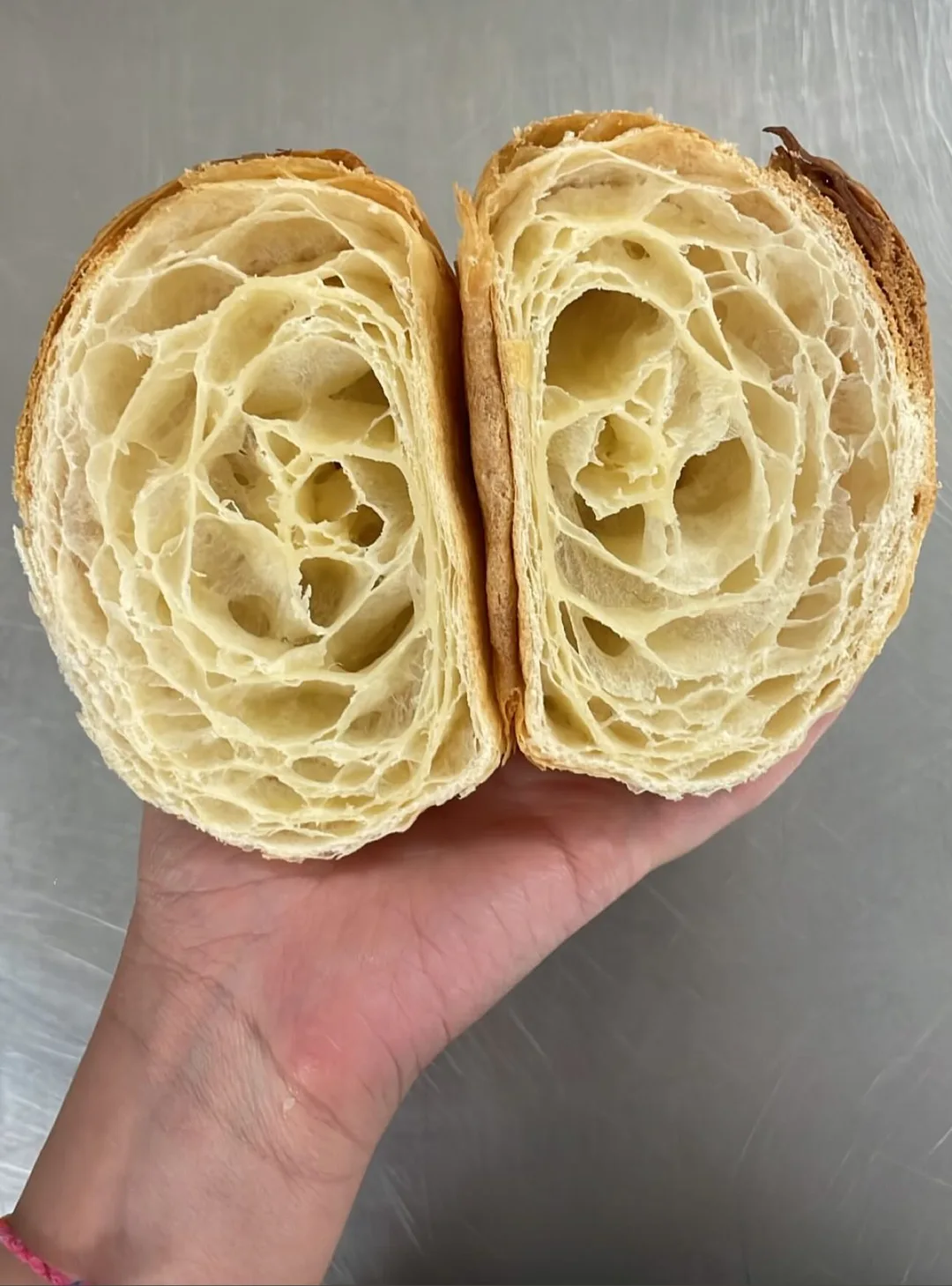
Our croissant: lamination explained
How butter and careful folding build layers in a Croissant - a process of patience, not speed.
When you break a Croissant and see dozens of thin layers pulling apart, that’s not an accident - it’s the result of a process called lamination, which takes patience more than speed.
The idea is simple on paper: dough and butter are folded into each other, layer after layer, until dozens of thin sheets of dough end up separated by even thinner sheets of butter. In practice, the process demands precision. The butter has to be at the right temperature - too cold and it will crack instead of spreading evenly; too warm and it will melt into the dough, and the layers will disappear. That’s why the dough rests in the fridge between each fold, so the butter and dough stay separate but flexible.
Every additional fold multiplies the number of layers, but it also raises the risk - dough handled too long or without enough rest loses its structure. That’s why our team doesn’t rush through this process. Resting between folds isn’t a step you skip to save time - it’s the step that gives the finished pastry its height, its flakiness, and that recognizable golden color when it comes out of the oven.
When the Croissant hits the oven, the heat turns the butter between the layers into steam, which literally lifts and separates the sheets of dough from one another. That’s the moment when all the earlier preparation shows itself - flaky and crisp outside, soft inside.
The same lamination technique stands behind our other pastries too, like Pain au Chocolat and the Almond Croissant, where an extra filling is added without disturbing the structure of the layers.
If you’re curious about the craft behind our pastries, next time you pass by our production in the early morning hours, you might catch a glimpse of this process in action. Until then, the layers in every Croissant tell their own story of the patience behind them.
It’s worth mentioning why this matters to you as a guest, not just to the baker. A croissant made without real lamination - rushed, with fewer folds or not enough resting time - simply won’t have the same layers or the same flakiness. The difference isn’t only visible, it’s noticeable on the palate too: a properly laminated Croissant breaks with light resistance, rather than compressing into a dense ball of dough. That’s exactly why this craft deserves so much attention, even when the finished pastry looks like a simple item on the counter.